Wednesday, 12 December 2012

Human Race's first Journey to the Moon

This post is about the first person ever to set foot and walks on the Moon in human history. He is a very important person in history when it comes to space subjects and is definitely a must know for all students.


Neil Alden Armstrong (August 5, 1930 – August 25, 2012) boarded the Apollo 11 on 14 April 1969 and journey to the Moon.
He then became the first astronaut to set foot on the moon surface on 21st July 1969.


As Neil set foot on the moon surface, he quoted the above sentence which is then well remember to this every day.


This is a picture of Neil's footprint for his first step on Moon's surface. As the Moon is a place without weather, the footprint is kept and still can be seen today.

Monday, 10 December 2012

Living Things Cannot Live On Some Planet Part 1


Dear friends, I have just finished preparing the materials for a new lesson and would like to share it with everyone. For tonight, I would like to show you some introduction to the lessons that I have planned. 

Subject                         : Science
Class                            : Year 4
Title                             : Living Things Cannot Live On Some Planet
Theme                         : Investigating The Earth and The Universe
Learning Area             : The Solar System
Learning Objective     : Appreciating the perfect placement of the planet Earth in the Solar
                                      System
Learning Outcome      : Pupils should be able to state why certain planets are not conducive
  for living things.
Strategy                       : Using comic pictures


Introduction: 


There you go!! The introduction to my new lesson materials. Stay tune for more tomorrow for the contents and after that I will add in a few more. Please feel free to comment too. Thanks!!!


Sunday, 9 December 2012

Facts about the Moon

A very clear picture of the moon surface.
 Here are some facts that you may teach your students regarding the moon.
  • The moon is not a planet, but a satellite of the Earth because it orbits around the Earth like a man made satellite would. 
  • The moon is about 1/4 the size of the Earth. 
  • The surface area of the moon is 14,658,000 square miles or 9.4 billion acres.

  • Only 59% of the moon's surface is visible from earth. This is because the moon is also rotating on its own axis.

  • The moon rotates at 10 miles per hour compared to the earth's rotation of 1000 miles per hour.

  • When a month has two full moons, the second full moon is called a blue moon. Another definition of a blue moon is the third full moon in any season (quarter of year) containing 4 total full moons.

  • From Earth, we always see the same side of the moon; the other side is always hidden.

  • The dark spots we see on the moon that create the image of the man in the moon are actually craters filled with basalt, which is a very dense material.

  • The moon is the only extraterrestrial body that has ever been visited by humans. It is also the only body that has had samples taken from it.

  • The first space craft to send back pictures from the moon was Luna 3 (built by the Soviet Union) in October 1959.

  • The moon has no global magnetic field.

Friday, 7 December 2012

The Lunar Eclipse


Today I would like to introduce another space phenomenon that is a relation between the Sun, the Moon, and the Earth.

The Lunar cycle occurs when the Sun, Moon and Earth are line up in a same line. It occurs when the Moon passes directly behind the Earth into its umbra (shadow). This can occur only when the Sun, Earth, and Moon are aligned exactly, or very closely so, with the Earth in the middle. Hence, a lunar eclipse can only occur the night of a full moon.


Prepare a diagram as the one above so you can explain to your students of the position of the 3 space objects when a Lunar Eclipse will occur.

Remember the previous post which we use objects such as the basketball, ping pong ball and marble to represent the different objects? Use them again to help your students understand better.


The diagram above shows the various stages of the lunar eclipse, this diagram can be shown to the students as lunar eclipse only occurs every few years, alternately teachers may also provide a video that recorded the occurrence of lunar eclipse.


 However if there is a chance when a lunar eclipse occurs, teacher may organize a night curriculum to watch the rare phenomenon together with their students, as they say, nothing is better than seeing for yourself.
Also, since the moon is not as bright as the sun, you may all see the lunar eclipse directly without wearing protective eye wear.

Monday, 3 December 2012

The Solar Eclipse

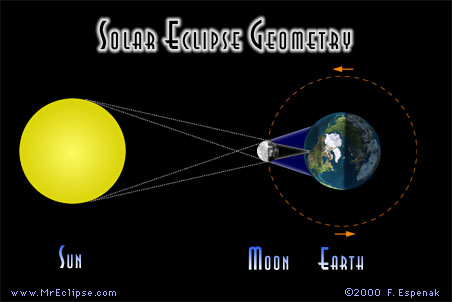
Solar eclipse occurs when the Moon is in line between the Earth and the Sun.
The Moon cast a shadow on the Earth's surface and covers some parts of the Sun. The proportion of the Sun being blocked depends on the position of the observer on Earth. Depending on the distance of the moon from the Earth, we may ovserve a partial of full solar eclipse from where we are at. 


This picture shows that the Sun, the Moon, and the Earth is lined up in a straight line and that is how a Solar Eclipse begins. 

What type of Solar Eclipse we can see depends on where we are at when it happened.
The following picture shows the different stages of a Solar Eclipse phenomenon.


If the teacher can prepare and allow the students to watch a Solar Eclipse, it will definitely be an experience of a lifetime
However, preparations must be conducted before the human eyes can witness the phenomenon, as looking directly into the sun is harmful to the eyes.

A simple glasses as seen below can be made out of cardboard boxes and camera film before presenting to the students.


Sunday, 2 December 2012

10 Interesting Facts About The Sun


Here are then interesting facts about the sun that I would like to share with everyone. 


1. The Sun is the Solar System
We live on the planet, so we think it’s an equal member of the Solar System. But that couldn't be further from the truth. The reality is that the mass of the Sun accounts for 99.8% of the mass of the Solar System. And most of that final 0.2% comes from Jupiter. So the mass of the Earth is a fraction of a fraction of the mass of the Solar System. Really, we barely exist.

2. And the Sun is mostly hydrogen and helium
If you could take apart the Sun and pile up its different elements, you’d find that 74% of its mass comes from hydrogen. with 24% helium. The remaining 2% is includes trace amounts of iron, nickel, oxygen, and all the other elements we have in the Solar System. In other words, the Solar System is mostly made of hydrogen.

3. The Sun is pretty bright. 
We know of some amazingly large and bright stars, like Eta Carina and Betelgeuse. But they’re incredibly far away. Our own Sun is a relatively bright star. If you could take the 50 closest stars within 17 light-years of the Earth, the Sun would be the 4th brightest star in absolute terms. Not bad at all.

4. The Sun is huge, but tiny
With a diameter of 109 times the size the Earth, the Sun makes a really big sphere. You could fit 1.3 million Earths inside the Sun. Or you could flatten out 11,990 Earths to cover the surface of the Sun. That’s big, but there are some much bigger stars out there. For example, the biggest star that we know of would almost reach Saturn if it were placed inside the Solar System.

5. The Sun is middle aged
Astronomers think that the Sun (and the planets) formed from the solar nebula about 4.59 billion years ago. The Sun is in the main sequence stage right now, slowly using up its hydrogen fuel. But at some point, in about 5 billion years from now, the Sun will enter the red giant phase, where it swells up to consume the inner planets – including Earth (probably). It will slough off its outer layers, and then shrink back down to a relatively tiny white dwarf.

6. The Sun has layers
The Sun looks like a burning ball of fire, but it actually has an internal structure. The visible surface we can see is called the photo-sphere  and heats up to a temperature of about 6,000 degrees Kelvin. Beneath that is the convective zone, where heat moves slowly from the inner Sun to the surface, and cooled material falls back down in columns. This region starts at 70% of the radius of the Sun. Beneath the convection zone is the radiative zone. In this zone, heat can only travel through radiation. The core of the Sun extends from the center of the Sun to a distance of 0.2 solar radii. This is where temperatures reach 13.6 million degrees Kelvin, and molecules of hydrogen are fused into helium.

7. The Sun is heating up, and will kill all life on Earth
It feels like the Sun has been around forever, unchanging, but that’s not true. The Sun is actually slowly heating up. It’s becoming 10% more luminous every billion years. In fact, within just a billion years, the heat from the Sun will be so intense that liquid water won’t exist on the surface of the Earth. Life on Earth as we know it will be gone forever. Bacteria might still live on underground, but the surface of the planet will be scorched and uninhabited. It’ll take another 7 billion years for the Sun to reach its red giant phase before it actually expands to the point that it engulfs the Earth and destroys the entire planet.

8. Different parts of the Sun rotate at different speeds
Unlike the planets, the Sun is great big sphere of hydrogen gas. Because of this, different parts of the Sun rotate at different speeds. You can see how fast the surface is rotating by tracking the movement of sunspots across the surface. Regions at the equator take 25 days to complete one rotation, while features at the poles can take 36 days. And the inside of the Sun seems to take about 27 days.

9. The outer atmosphere is hotter than the surface
The surface of the Sun reaches temperatures of 6,000 Kelvin. But this is actually much less than the Sun’s atmosphere. Above the surface of the Sun is a region of the atmosphere called the chromosphere, where temperatures can reach 100,000 K. But that’s nothing. There’s an even more distant region called the corona, which extends to a volume even larger than the Sun itself. Temperatures in the corona can reach 1 million K.

10. There are spacecraft observing the Sun right now.
The most famous spacecraft sent to observe the Sun is the Solar and Heliospheric Observatory, built by NASA and ESA, and launched in December, 1995. SOHO has been continuously observing the Sun since then, and sent back countless images. A more recent mission is NASA’s STEREO spacecraft. This was actually two spacecraft, launched in October 2006. These twin spacecraft were designed to watch the same activity on the Sun from two different vantage points, to give a 3-D perspective of the Sun’s activity, and allow astronomers to better predict space weather.